
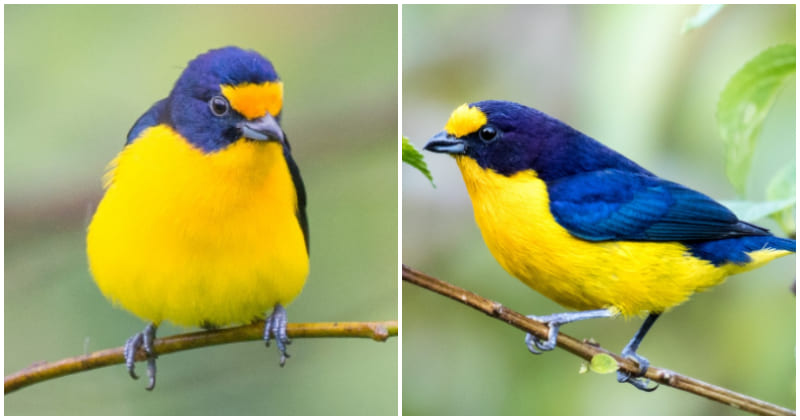
The family Fringillidae is famous for its little but colorful member species and this bird below is definitely a fine example.
Let’s meet the violaceous euphonia!
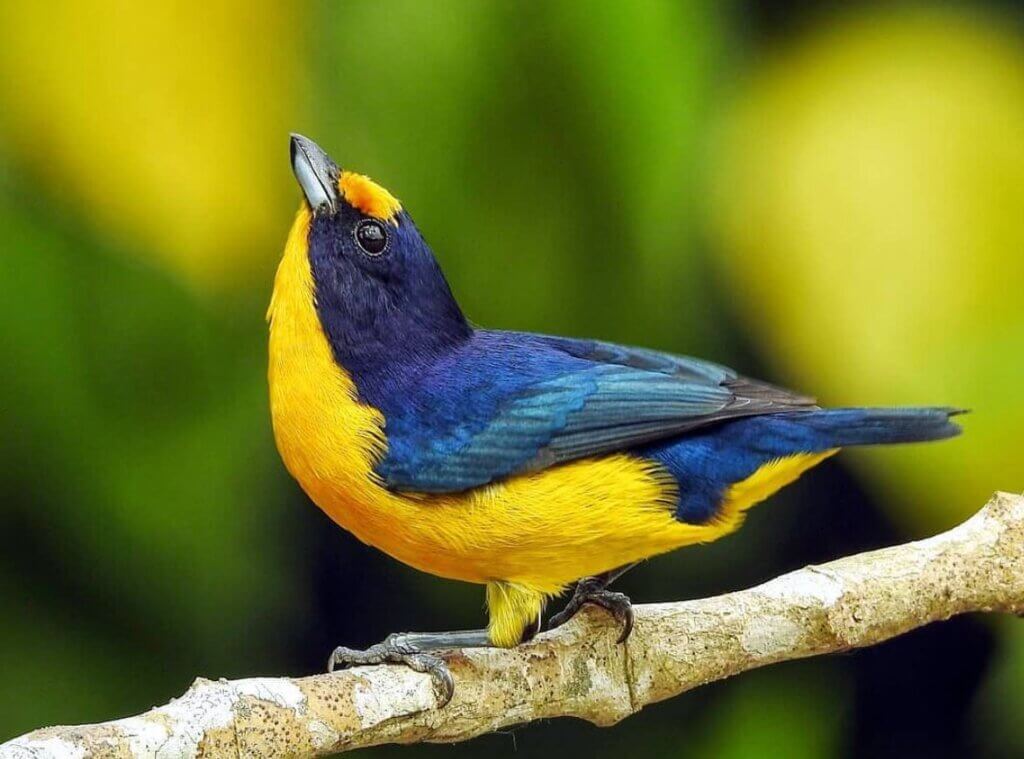
The violaceous euphonia (Euphonia violacea) is a small passerine bird in the true finch (Fringillidae) family. This bird is measured only 11.4 cm in length and 14 g in weight. However, it has a truly gorgeous appearance.
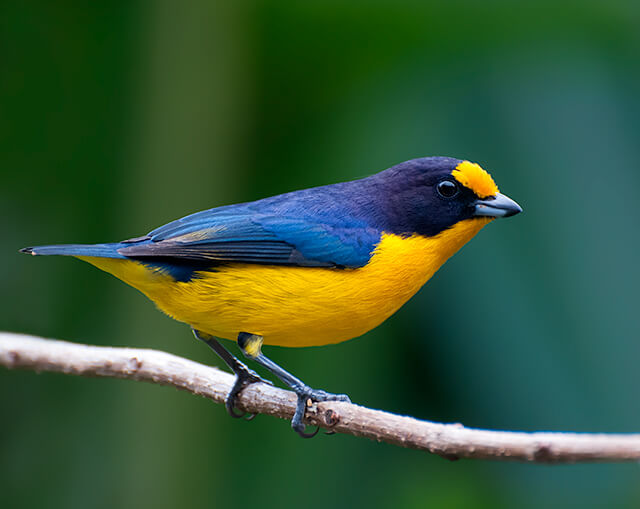
The male birds are covered in glossy blue-black and deep purple plumage, with bright yellow underpart. Their throat and forehead are also colored deep golden yellow, with a white undertail part.
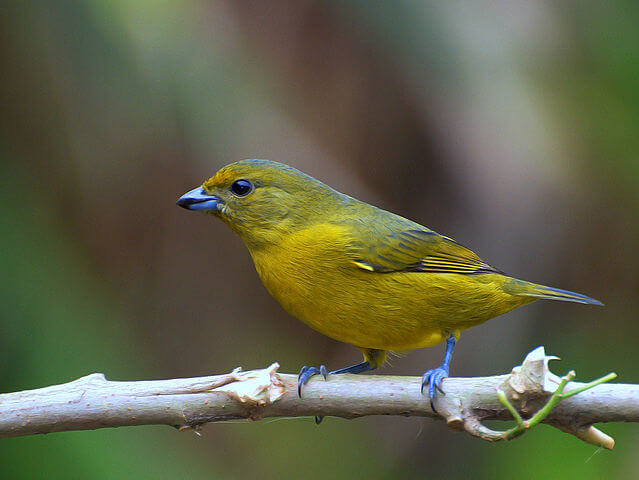
The female birds look paler with olive-green above and greenish-yellow underpart. Juvenile birds of this species resemble the female. This species has a short and strong beak, colored in bright blue with a darker shade on the tip; its legs also have a bright blue color.
When they mate, the couple will build a nest on a bank, tree stump or cavity. The female will usually lay four eggs inside and incubate them by herself.
Their genus Euphonia is currently threatened because of human impacts. They are prized as cage birds and are trapped in large number. This species, violaceous euphonia, is somehow luckier thanks to its relatively inaccessible habitats and unsuspected lifestyle. However, that also leaves us with limited information about it.
In its homeland in South America, they can be found at forest edges and sometimes open woodlands, shrubby areas, and urban parks all year round.
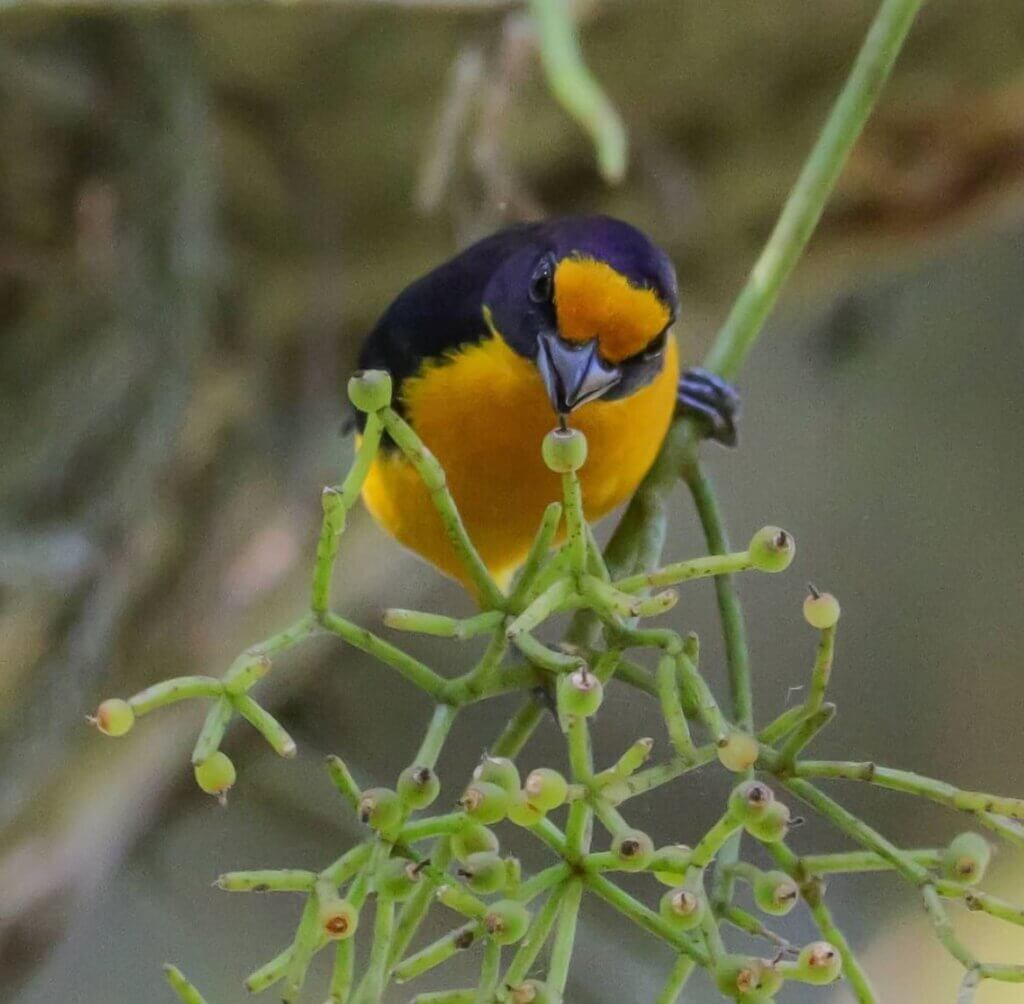
Their range covers a vast region from Venezuela south to Paraguay and northeastern Argentina. They also inhabit the eastern part of Brazil and the Guyanas. Their menu consists mainly of fruits and more often than not, insects. Especially, these little birds have a strong taste for mistletoe berries, a poisonous fruit. Their guts have evolved to be highly adapted to digest these berries.
WATCH THIS BIRD RIGHT HERE IN THE VIDEO BELOW:
H/T: One Big Birdcage